
By Josh Poole and Travis Wellman
The city had been reduced to smoldering rubble in the dead of winter, but still the detached remnants of the army tended to its defense. Four hundred souls remained in the wreckage, parceled out in disparate groups. Their orders were simple: sit tight, hold the line, and above all else, don’t bake anything.
In the skeletonized remains of a brick warehouse, two soldiers, the willowy Private Montgomery, and barrel-chested Sergeant Jones, stood next to an oven. Their rations long-devoured, they’d been reliant on what had been a well-stocked pantry, cooking the food under the din of artillery.
“350 degrees for forty-five minutes,” Montgomery reiterated, staring at the stove glass as if it were an altar triptych.
“They’re coming. The shelling stopped,” replied Jones.
“It’s been in there for thirty minutes already.” Montgomery stole a glance at his watch. “I shouldn’t have made the icing from scratch.”
“First you hear the guns, then the boots, then the screams,” Jones said with a sigh, running a nervous hand through his hair.
“It’s rising nicely,” Montgomery replied. He leaned against the oven, feeling the warmth of its inner furnace breathe feeling back into his hands.
The stove was, it seemed, the only part of the house untouched by the war; a resilient heart beating inside a lifeless carcass. Its burners were marred by rust, but the glass was clear as a summer day.
Within minutes of the artillery barrage halting, the sound of boots began to chant through the streets. Damp thuds of soles on pavement turned into the deep, hollow knocking of heels on the hardwood floors in a neighboring ruin.
“Have you seen my helmet?” Montgomery asked.
“You used it for the batter,” Jones rolled his eyes. “Wouldn’t help at this range.”
“I know,” Montgomery found his helmet on a cluttered table. “I wanted to finish licking it.”
“Cut the oven off, they’re close.” Jones grabbed his M1-Garand.
“Negative. I spent two hours putting together that cake,” Montgomery replied, pulling his Thompson machine gun off the counter.
Montgomery checked the chamber of his firearm and allowed the bolt to slam forward with a loud Thwack. Jones shot him a look that Montgomery didn’t seem to notice. The steps drew closer, and they could hear voices speaking foreign, dangerous tongue.
“How many are there? Can they help with the cake?” Jones asked, moving to watch the front door at the bottom of the stairs.
“Four, maybe five,” Montgomery peered through a broken window as the enemy soldiers filtered out of the nearby building, “no chef’s hats.”
Jones finished licking the last morsel of batter from the spoon. “I don’t think we’re going to have time for cake.”
The enemy soldiers moved slowly, crouched along a stone wall that separated the buildings, making their way toward an opening where a shell had blown the wall apart. Each of them slithered through, carefully, now completely quiet.
Montgomery plucked a grenade from a strap that spanned his chest.
“Give it to them when they get under the window,” Jones instructed. “They may intend to ask for flour.”
“Open the front door. Tell them we don’t have any.”
Jones slipped down the stairs to stand by the front door. He could hear the footsteps sliding through the tall grass outside along with soft murmurs. Should the grenade fail to take care of the group, he wasn’t feeling good about his odds, taking a mental tally of eight rounds in his weapon. One, two, three, four, five, six, seven, eight, each chiming in his head.
Montgomery pulled the pin on the grenade, holding the lever and waiting for a signal. Jones slowed his breathing, knowing the enemy would be spraying into the house the moment he kicked open the door. He’d have to move fast, but he’d moved fast before.
The timer on the oven dinged.
“Could I have the German chocolate cake?” A voice quaked through the scene.
Gone were the ruins, the enemies, the grenade waiting in the upstairs window, all replaced by a simple café counter where a menagerie of confections waited within glass.
“Yes,” Jones replied, pulling a slice of chocolate cake out from its display and handing it across the counter. “A dollar and eight cents.”
A young woman handed the exact change over the counter.
One, two, three, four, five, six, seven, eight. Jones counted off in his head.
The woman left, and Jones, now in his forties, wandered into the back of the bakery where a large oven hummed, another man watching it with a bowl of batter in his lap.
“Three hundred and fifty degrees for forty-five minutes,” Montgomery said.
“The next wave will be coming in about two hours, but that’s the last of our lunch rush,” Jones replied.

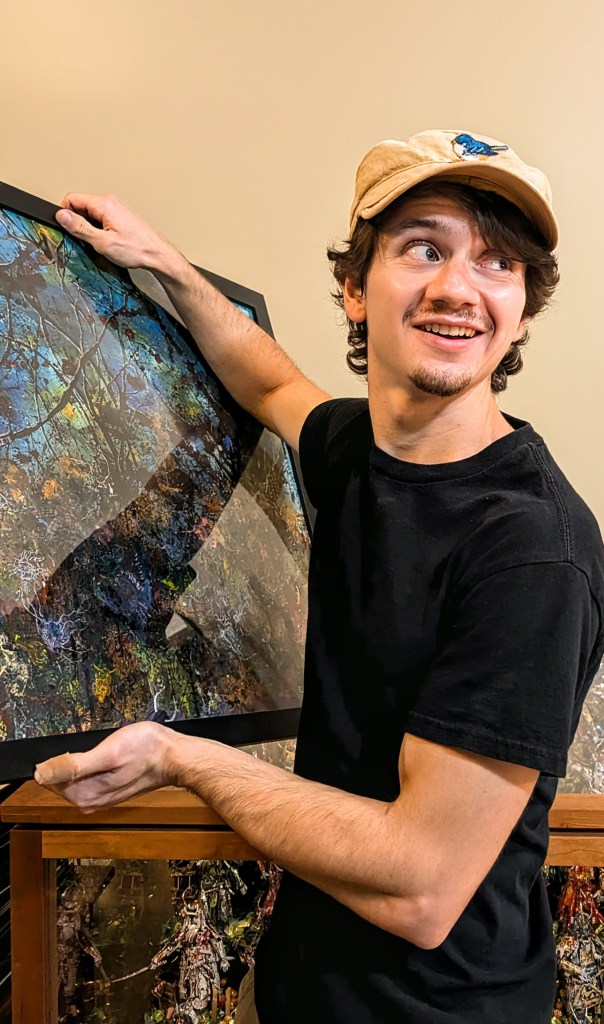

 Josh Poole and Travis Wellman: Authors
Leave a comment